
|
|
||||||||||||||||||


| 2026-2027 Electoral Calendar, latest official version |

|
 |
|
|
|
|
|
|
|||||||
|
|
Haiti - Epidemic : Between disinformation and reality
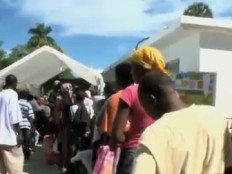
The Director General of the Department of Health in Haiti, Gabriel Thimothé, confirmed Monday that the rate of increase in deaths from cholera had slowed. However, the number of infections has increased by nearly 10% since Sunday, from 3115-3342. "We believe that the situation stabilizes. This does not necessarily mean that we have reached a peak" We continue the implementation of Cholera Treatment Centers (CTC). One such center is under construction at Lesters, in the Artibonite, while 4 sites were identified in the metropolitan area of Port-au-Prince who must ultimately accommodate 10 CTC. Government authorities and health in Haiti agree to mass communication to the reassuring people. However, many voices, great reputations specialists on site and outside the country put in doubt every day a little more the reality of a situation which one would like to make us believe "under control". Of course we must avoid being alarmist but it is useless to deny reality, the world must know, to lie has never to dam up an epidemic. To mislead a population is not a remedy. The figures "certainly underestimates the true number of cases," said Dr. Jon K. Andrus, assistant director of the Pan American Health Organization (PAHO), saying that in general, 75% of people infected with cholera do not develop any symptoms . However, they can release bacteria into the environment over a period of up to 2 weeks after infection and can infect others. The risk is particularly high in areas where good hygiene is lacking, as in many parts of Haiti and especially the camps. "From the time the cholera was firmly established in Haiti, it is clear to us, it will not disappear for several years" "We expect a gradual extension of cholera in the country, and how it will still unpredictable," said Michel Thieren, a PAHO official in Haiti. A nationwide epidemic with tens of thousands of cases is a real possibility. "This is an extremely serious situation and on the basis of the experience we have epidemics elsewhere in the world, it would be irresponsible not to plan in the event of a much larger epidemic," said Mr. Nigel Fisher, coordinator of UN humanitarian action in Haiti. Michel Van Herp MSF's medical advisory for the team of the organization, said that previous experience of response to cholera in Latin America in the early 1990s, "we suggest that the disease could easily spread over large areas and may incubate for a certain number of days to show symptoms." [NdHL - When cholera came to touch the refugee camps the situation is catastrophic, just look at the effects of cholera in refugee camps in Rwanda in July 1994 that killed nearly 23,800 people]. Dr. Ernst Robert Jasmin, the departmental director of Public Health speaking on the airwaves of Port-au-Prince reported that 17 probable cases of cholera, including three deaths have been reported in recent days in the north. Health officials await test results before ruling on cases of diarrhea in care particularly in regions of the Northern Department, Port-au-Prince and Arcahaie (West). There is still a significant number of patients present at the Saint Nicolas Hospital in the town of Saint-Marc, near the epicenter of the epidemic. Approximately 450 patients were treated daily for two days, including those who received oral rehydration solution (ORS) and intravenous treatment said Federica Nogarotto, MSF field coordinator in Saint-Marc. See also: https://www.haitilibre.com/en/news-1510-haiti-health-the-cholera-epidemic-is-here-to-stay.html https://www.haitilibre.com/en/news-1509-haiti-epidemic-cholera-nationwide-a-real-possibility.html S/ HaitiLibre
|
|






|
|
Why HaitiLibre ? |
Contact us |
Français
Copyright © 2010 - 2026 Haitilibre.com |