
|
|
||||||||||||||||||


| 2026-2027 Electoral Calendar, latest official version |

|
 |
|
|
|
|
|
|
|||||||
|
|
Haiti - Agriculture : More than 250 Farmer Field School in Haiti
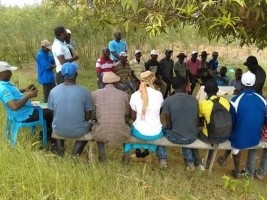
The Ministry of Agriculture with the technical assistance of the Food and Agriculture Organization of the United Nations (FAO) has made the Farmer Field School approach (CEP - Champs Écoles Paysan) a preferred approach to agricultural extension for Haiti perfectly adapted to the practices characterizing Haitian agriculture. 8 years after the introduction of this approach, more than 250 CEP are installed throughout the country. With more than 14 different themes addressed such as: Conservation agriculture techniques and techniques of agriculture on sloping land, multiplication and use of improved seeds, storage of agricultural seeds, processing of agricultural products among others, the Farmer Field School in Haiti has the merit of proposing varied answers to the problems most commonly encountered in Haitian agriculture. The first beneficiaries are the farmers for whom the experiment proves to be a truly beneficial innovation. Farmers acknowledge that the results obtained in the CEP made them aware that their "lands were anemic" before adopting and implementing good agricultural practices. "We realized that we had to feed the land so that it could feed us more, to make more profits [...] We did not understand what we were doing before. Our work and our efforts were simply futile [...] The peasants testify to their legitimate satisfaction. "Before the CEP, when we plant a pot of beans, we only harvest 5, sometimes 6, whereas now, with the practices of the CEP, for a pot of beans planted, we harvest no less than 15". "Encouraging people to work together reminds us of how our grandparents are doing in the konbit," says Robert Joseph Sylvestre, the departmental agricultural director of the Center. Within the CEP, which is nothing other than a space of practices, exchanges of knowledge and collective learning, the Haitian farmers refer to their own practices that they learn to develop with the methodology inherent to the approach, in order to enhance their land. The peasants, like those practiced in the other Farmer Field Schools, learn together and then replicate what they have learned. CEP days are organized, where farmers come to discuss the difficulties encountered and share the ways in which they have overcome them. However, despite the farmers' interest and the relatively convincing results, the CEP suffer from a lack of harmonization in their implementation by different partners. Hence the need to institutionalize this approach in order to make it sustainable. The CEP guide currently being developed by the Ministry in collaboration with FAO should provide guidance for their establishment and management. HL/ HaitiLibre
|
|






|
|
Why HaitiLibre ? |
Contact us |
Français
Copyright © 2010 - 2026 Haitilibre.com |