
|
|
||||||||||||||||||


| 2026-2027 Electoral Calendar, latest official version |

|
 |
|
|
|
|
|
|
|||||||
|
|
Haiti - Health : Special Assemblies on the Health
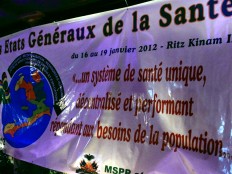
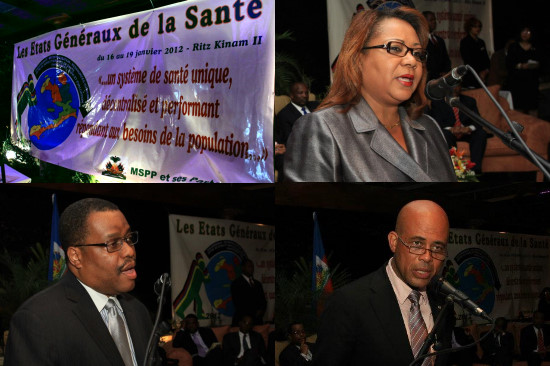
The President Michel Martelly, in the presence of the Haitian Prime Minister, Dr. Garry Conille, members of government, of the diplomatic corps, parliamentarians, stakeholders and funders of the health system, officially launched this Monday, January 16, 2012 at Ritz Kinam II, a 4-day Special Assemblies on the Health around the theme "A health system unique, decentralized and efficient to meet the needs of the population". This Assemblies, conducted under the patronage of the Presidency proves, once again, the commitment of the President, to make efficient the achievements of various ministries. It shows, at the same timethe need to bridge the gaps in the health system to make health care accessible to all citizens. The Head of State, believes in a health system equitable allowing all children to have access to health, to the youth to fulfill their role in wealth creation and to all Haitian to have the opportunity to grow in a country where life is good.
In her speech, Florence Duperval Guillaume, Minister of Public Health and Population declared "...the offer of care and services, such as the desire to know, can not be presupposed, it is built step by step and is forged in the light of our daily lives, our demographics, our social reality, economic and political. Our great challenge is to achieve to reduce the risk of the population to be affected by a disease, I call on the protection of health, to arrive to keep it in health and restore that of the sick peoples. The challenge is considerable, because it is in fact, to avoid a real risk of runaway of health inequalities that may widen even more, those created in our society today. That is why it seems urgent to act, by taking innovative methods, relieve of any form of medical paternalism, to meet this challenge with the means to promote a greater equality of opportunity of access at least, to care and basic services. It appears necessary to extend this problem of social inequality in health from that which crosses the society as a whole, without diverting attention from the specific problems to the sectors faced by the most fragile. Also, remove financial barriers to care, must be part of our thinking. More clearly, I speak of health financing, with the philosophy of putting the user at the center of the system, not only as beneficiaries but also as a financial contributor, if it has the means, the State reserves to itself the responsibility of the weakest links of the chain social. This funding approach should allow us to tend progressively, not only towards less dependence by 20-25 years, but more importantly, towards the paternity of our assets, the legal aspects to get there, should not be excluded. As for the issue of human resources, key pillar of the system, it's all-out that we must fill, the type of human resources requires by this new vision, to reach at the same time a real depoliticization, designed more for the individual interests or of groups, rather than worrying about a real offer of care and services to the population. Beyond the conventional resources, should we not think about developing other models, who adequately supervised could acquire the necessary skills and contribute more effectively to the answer ? Many of our resources and living abroad, we should learn to integrate them into our programming. Finally, the issue of retention must be addressed comprehensively, by defining among other things, an architecture of incentives clear and fair, especially for those working in remote areas. Levers that will allow to address the determinants of the health, to reduce the critical findings that are not only sanitary, the employment, education, environment policies that have significant effects on the social determinants of health. Transversality issues, implies a change of mentality and way of doing, for sectoral and multi-disciplinary approach..." S/ HaitiLibre
|
|






|
|
Why HaitiLibre ? |
Contact us |
Français
Copyright © 2010 - 2026 Haitilibre.com |